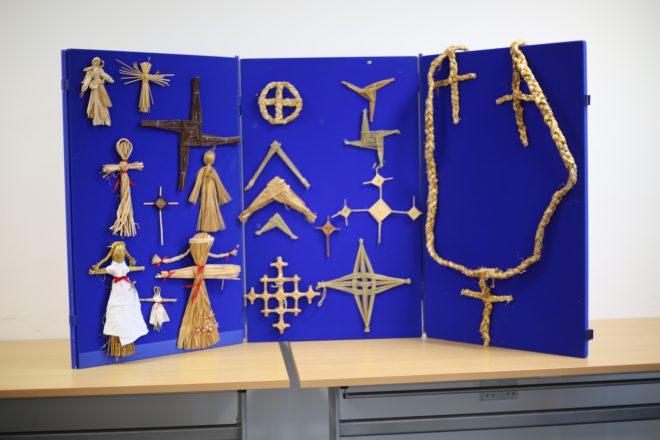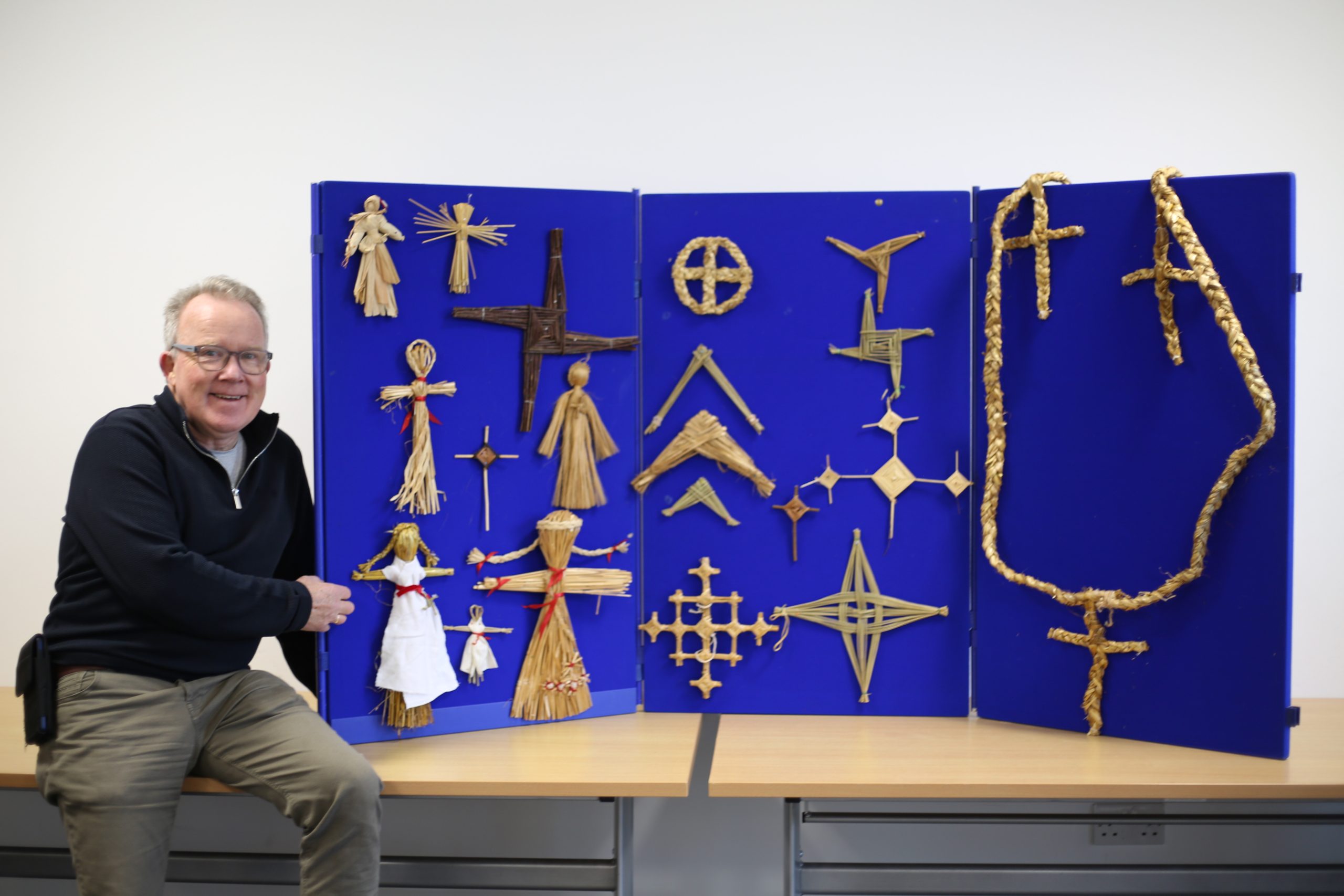


EVEN after last year’s 1500 anniversary of the death of the historic ‘Brighid’, she is increasingly viewed in folklore circles as an all-important bridging figure between a pagan Earth mother goddess and Ireland’s first Christian saint.
For local folklorist Jim Ledwith, Brighid’s legacy endures and lives on in the minds of people, marked annually by the hugely popular folk custom of creating and putting up a variety of rush-made Brighid crosses, crucially over the threshold of the main entrance door of houses, barns and public buildings.
This week, to mark St Brigid’s Day this Sunday, below Jim explores the rich heritage of this tradition which, as he explains, takes many forms.
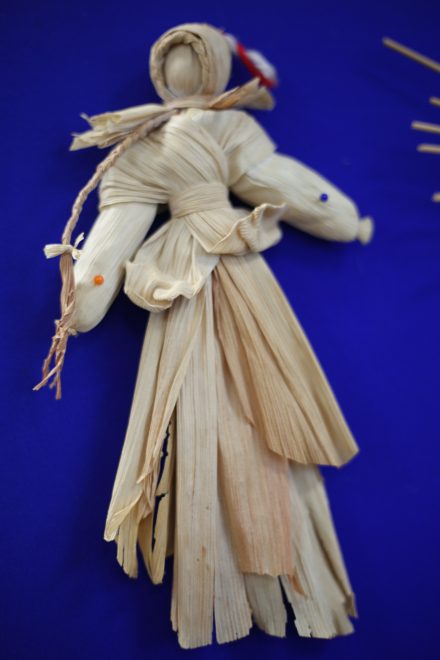
There are many distinct but lesser-known Brighid customs, such as the making of Biddy straw doll effigies, known as Brídeoga.
Others include Brighid straw girdles, which are looped straw belts with three inserted crucifixes, or ‘rush lights’, which are dipped in melted pig fat.
Another involves Brighid cloth mantles invoking her protection, healing and fertility powers.
However, it is people’s unwavering belief in the protection that the humble Brighid crosses provide, being hung above the main entrance all year round, against storms, fire, lightning and evil for all humans living within households that has stood the test of time.
Three-legged rush crosses hung over the threshold of farm buildings offer the same protection to animals within.
With a background in masked rituals, the ritual of house visitations by masked Biddy boys on Brighid’s Day, which died out in Fermanagh in the early 1950s according to renowned folklorist Kevin Danaher, is of particular interest.
In essence, the ritual took the format of a parade of young children masked in straw “get-up”, bearing aloft a straw-made humanoid effigy of Brighid, cloaked in white cloth and adorned with red flannel (mader).
On entering the household, a rhyme was recited for the poor Biddy’s burial and, in return, food or money was given for a Biddy boys’ feast on the same night. A blessing was bestowed on the household by the Biddy boys’ visitation.
Slowly but surely, a collection of Biddy dolls continues, but of particular importance is the parallel recording of reminiscences of Brighid customs from the remote Gaeltacht areas of north-west Donegal.
An elderly Tory Island woman never forgot the time in her very young age when her parents instinctively reached for the Brighid cross when lightning and thunder were heard overhead the home and it was thrown quickly into the fire inside the hearth to protect the house from all harm.
Another story from an 88-year-old Annagry native on the nearby mainland recounted the tradition of leaving salt out on Brighid’s Eve for Brighid’s blessing.
The salt was then inserted into a sock and hung around the necks of those suffering from sore throats.
As for leaving a piece of cloth outside on Brighid’s Eve, it too was imbued with powers of protection and healing. So much so, it was used to put over the stomachs of women to lessen the pains of childbirth.
To this day, red flannel mader cloth left outside is much sought after by midwives. For fishermen, a piece of Brighid’s cloth was either stitched onto their clothing or else tied to the boat whilst at sea and, for many, a miniature piece of Brighid’s cloth or cross is still hung in cars for protection.
Another much less-known ritual was that of Brighid’s girdle – an elongated, circular plaited straw rope with three inserted plaited straw crosses.
On passing through the looped circular hole of the girdle, going from one side to the other, the participant received Brighid’s blessing and was deemed cleansed from the winter.
There were distinct forms of passing through the girdle for both men and women. Even huge straw girdles were hung around the entrance doors of barns for wintered cattle to pass through, with the implication of Brighid’s blessing when being let out onto fresh spring pastures.