


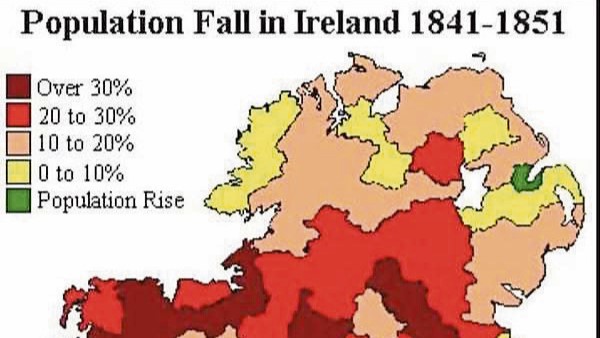


A MAP showing the population fall across Ireland during the years of the Great Famine, which has been widely shared on social media recently, highlights how Fermanagh was one of the worst affected areas in Ulster.
The map, which appears to have been originally posted by roads expert Wesley Johnston and later on Wikipedia before going viral recently, shows the drop in population across Ireland between 1841-1851.
While vast swathes of Ulster appear to have been relatively unaffected compared to the south, particularly Donegal and Derry, Fermanagh and its neighbours in Cavan and Monaghan were among the worst impacted areas in the country.
According to historian Margaret Urwin – author of ‘A history of Fermanagh, from the Plantation to the present’ – has noted Fermanagh lost a total of 25.8 percent of its population during the Famine.
Other sources, such as Fermanagh Genealogy, put the population drop closer to 33 percent, noting the county lost around 60,000 people between 1841-1851.
Regardless of the exact figure, the impact of what was the darkest period in Ireland’s history was especially severe here in the lakelands, and this tragic legacy is still on view across the county today, if you know where to look.
For example, a memorial stone stands on the site of the Famine-era workhouse in Irvinestown. At its height in the 1840s, the institution housed almost 800 inmates.
There is a ‘famine pit’ near St Mary’s Church in Ardess, where some of these former inmates were laid to rest. It is believed the bodies of over 200 local people who lost their lives in the Great Hunger are buried at the site.
“Poor people from North Fermanagh made their way to the workhouse in Irvinestown,” said historians from Enniskillen Castle museum.
“Others were not so lucky and died in their poor hovels. Later they were buried in St Mary’s Church of Ireland graveyard.
“Not for them the finely sculpted tombstones of their better off neighbours but instead a pit in the ground without a marker to record their final resting-place.”
Unlike Irvinestown, the Famine-era workhouse in Lisnaskea and Enniskillen remain today, with the Enniskillen building being transformed in recent years to a state-of-the-heart enterprise hub serving the local community.
The is also a memorial in Enniskillen, not too far away from the Workhouse, in Cornagrade, marking the site of the ‘Paupers Graveyard’, created to deal with the mass deaths of that dark time.
Fermanagh was actually one of the first places in Ireland where the devastating potato blight was first detected.
According to the historians at Enniskillen Castle, “The first report of blight in Ulster was in Fermanagh on 28th August 1845.
“In that month the Earl of Erne wrote to the Royal Agricultural Improvement Society of Ireland reporting: “many instances of a total failure of the potato crop in County Fermanagh.” By early September blight was reported throughout Ireland. The potato crop was to fail for the next four years.”
To read more on this story see this week’s Fermanagh Herald. Can’t get to the shop to collect your copy? No problem! You can download a copy straight to your device by following this link… Subscribe to current edition