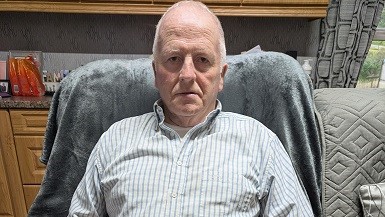


A FERMANAGH farmer has shared a harrowing hospital ordeal that left him fighting for his life with sepsis after days of delays in treatment, which he believes nearly cost him his life.
Sean Cox from Kinawley spent over 24 hours in the SWAH emergency department (ED) without treatment and was only diagnosed with sepsis more than 32 hours after a two-hour journey to Altnagelvin Hospital in Derry.
The 67-year-old feels this led to his condition to deteriorating critically.
“If I had been treated there, my recovery would have been much faster. Instead, my condition was allowed to escalate,” Mr Cox said.
Mr Cox had undergone a successful knee replacement on December 9 and was discharged in good condition two days later.
Recovery initially went well, but in the early hours of December 18, he suffered a seizure.
The following day, his GP advised he go to the emergency department (ED) by ambulance, fearing a possible heart attack.
He arrived at Enniskillen SWAH ED that afternoon but was not seen until midnight, after an eight- to nine-hour wait.
Mr Cox was told he had an infection that might be related to his knee surgery and needed to be transferred to Altnagelvin in Derry because he had to be seen by the orthopaedics unit.
He had to wait two days for a bed to become available at Altnagelvin, and then no ambulance was available, so his son had to drive him two hours to Derry while he was seriously unwell.
“If I had another seizure or gone into cardiac arrest in the car, neither of us would have known what to do. That journey was terrifying,” he said.
“When I got there, I fell asleep and then I started having seizures. I was on the verge of cardiac arrest or a stroke,” he said.
Doctors diagnosed him with sepsis and immediately started strong antibiotics. He remained in hospital over Christmas and New Year.
One doctor warned bluntly, ‘if we don’t treat this, it’s deadly,’ while another said that had he been ten years older, he might not have survived.
He is speaking out to raise awareness and prevent others from suffering similarly.
“I recently read about a man who died from sepsis after waiting for care. The only difference between me and him is that I’m alive. Every week, you read about someone dying from sepsis,” he said.
“The waiting and uncertainty were traumatic. I genuinely thought I was going to die.”
“I treat sick animals for a living, and I know that the quicker you treat illness, the better the outcome. This is playing with people’s lives,” he continued.
Save Our Acute Services (SOAS) campaign group said they were ‘hearing the word sepsis too often.’
“People of all ages are developing sepsis and associating it with extended waits across both hospitals and an unsafe provision for people with our postcode.
“We encourage people to continue speaking out because this is not about the quality of frontline care when is applied, on the contrary, it is about the hours and the gaps when it is not applied.”