


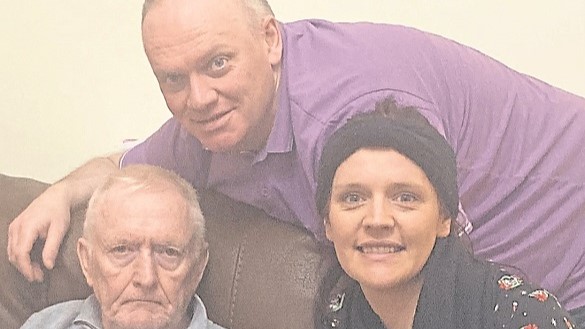


A LOCAL man living with Huntington’s has said a recent breakthrough in the fight against the disease has given him hope for his children and grandchildren’s futures.
Brian Fee was diagnosed with Huntington’s disease 10 years ago at age 53, following a fall at work. Since then, he has experienced mobility issues, slurred speech, and short-term memory loss.
Huntington’s is a rare, inherited neurological disorder that gradually breaks down nerve cells in the brain, affecting movement, thinking, and behaviour. Currently, there is no cure.
After the death of his wife, Maggie Fee, a passionate advocate for Huntington’s awareness, his daughter, Claire Fee, became his full-time carer.
“Watching someone you love suffer with this disease is utterly heartbreaking,” Claire said.
“To see the man who raised you, protected you, and did everything for you slowly lose pieces of himself, it’s painful.”
Huntington’s first touched the Fee family when Brian’s brother, Paul, showed early symptoms and was eventually diagnosed with the disease. He died 22 years ago, but the diagnosis left a lasting mark on the entire family.
“That’s when we first learned what Huntington’s was,” Claire explained. “That it’s hereditary and that it could be passed on.”
Since then, 15 members of the wider family have tested positive for the Huntington’s gene. Claire and her brother Barry haven’t had the test, but both live with the knowledge they have a 50/50 chance.
“Everyone with the gene will eventually develop symptoms,” Claire said. “It’s not if, but when.”
At 40, she’s chosen to wait.
“I still feel too young to know,” she admits. “I want to get my life in order before facing that reality.”
Her fears aren’t just emotional. “People don’t realise how much a terminal diagnosis affects everything, life insurance, the future.”
Still, she and Barry have made a promise, “If our children ever ask us to take the test, we will. No question.”
New treatment
Last week a revolutionary gene therapy has shown it can slow Huntington’s progression by up to 75 per-cent. The treatment involves brain surgery to inject therapy directly into affected areas.
Claire remembers Brian’s reaction at the news.
“I’ve never seen him move so fast. He was shouting for me to watch the news,” she said.
Brian said he was overwhelmed with joy.
“Absolutely brilliant. I’m delighted. I never thought I’d see this happen,” he said. “It stopped me in my tracks in a good way.”
For Brian, hope is bigger than himself.
“At this stage, it’s not about me,” he said. “I’d trade my own health if it meant protecting the next generation.”
When his brother died, there was little information or support.
“There still isn’t enough,” Brian admits, “But there’s more now and that gives me hope.”
The breakthrough has made Claire rethink everything.
“It makes me seriously consider getting tested,” she said.
“If there’s a treatment, I want it early but I really hope it comes in time for my dad. Slowing it now could give him years he might not otherwise have.”
Brian’s biggest worry isn’t himself.
“It’s about us,” Claire said. “Me, my brother, his grandchildren. That’s what matters most to him.”
The treatment is still in its early stages, and it could be years before it’s widely available but it brings families like the Fee’s hope that Huntington’s won’t have to define their futures.