


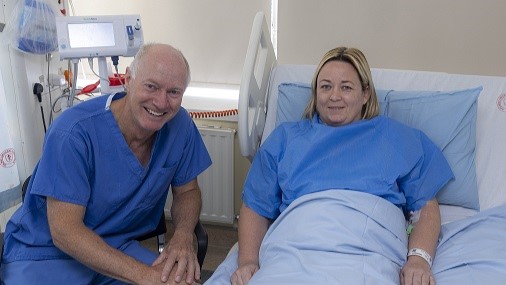


A Ballyshannon woman has become the first patient in the world to receive a revolutionary new treatment designed to treat complex venous obstructions.
Kelly Coughlin’s successful treatment, which was performed at University Hospital Galway (UHG), marks a major milestone in the management of chronic venous disease.
The hospital has achieved a global medical breakthrough by becoming the first in the world to successfully trial a revolutionary new catheter device, designed to treat complex venous obstructions, particularly blocked or damaged leg veins that have previously been stented and fail to return blood efficiently to the heart.
The Recana Thrombectomy Catheter System, developed by InterVene, is a minimally invasive device is inserted through a small incision in the leg, allowing clinicians to access and clear previously obstructed veins.
This restores healthy blood flow and offers new hope to patients who have exhausted all conventional treatment options.
“This marks a significant advancement in the treatment of chronic venous disease,” said Professor Gerry O’Sullivan, Consultant Interventional Radiologist at University Hospital Galway, who led the procedure.
“The long-term impact of venous obstructions, especially in previously stented vessels, can be life-altering. I had attempted to recanalize this patient’s veins four times without success. The Recana system achieved this in a single session. That speaks volumes about its potential.”
“It offers a powerful, minimally invasive solution for patients who have exhausted conventional treatment options,” added Professor O’Sullivan.
Ms Coughlin, the first recipient of the treatment, shared her experience: “This procedure has been massively life changing for me. When I was symptomatic, even simple tasks like walking were a challenge.
“I’m incredibly grateful to Professor O’Sullivan and his team at University Hospital Galway. I’ve been under his care for many years, and that long-standing trust gave me the confidence and reassurance I needed to proceed with this treatment.”